November 2026
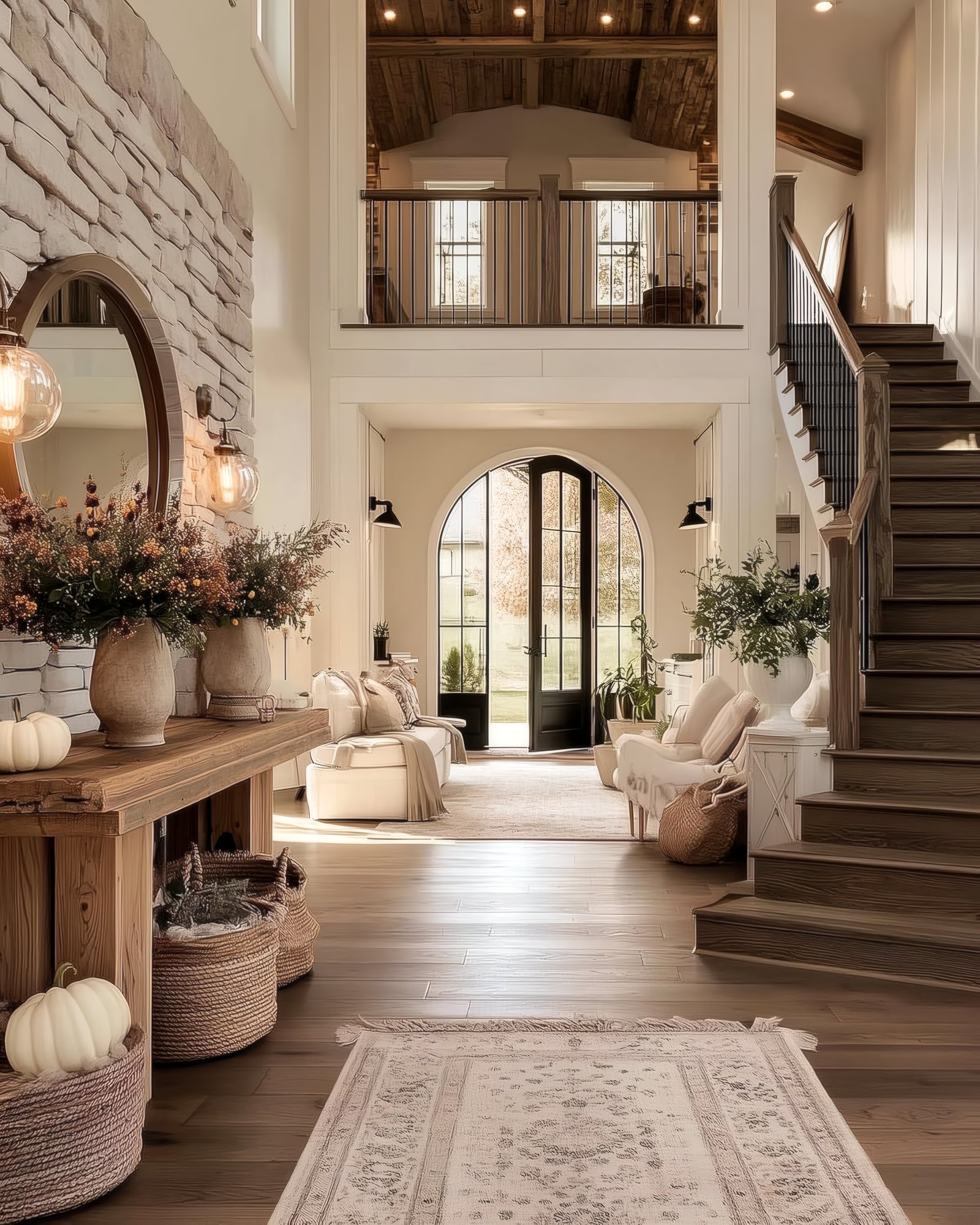
Stone inside a house does something paint and drywall never will. A fireplace surround, a wall in the stair hall or an arch into the kitchen gives a room weight and a sense of age. Owners who ask us about it usually have a picture saved, and the first thing we ask back is which kind of stone they mean. Full stone and thin veneer can look nearly the same once they are up. They make very different demands on the wall and the floor behind them, and that choice comes before any talk of color or shape.
Full-bed stone and the floor under it
Full-bed stone is natural stone at its normal depth, laid course by course like a real wall. It is heavy. Stacked up the face of a fireplace or across a stair hall, it puts a load on whatever it sits on that an ordinary wood floor was never sized to carry. On a concrete slab, that may be manageable. Over floor joists, the framing usually needs reinforcing, or the stone needs its own support carried down to the foundation.
It also takes up room. A full stone wall stands out from the framing by the depth of the stone plus an air space, and it gets tied back to the wall with metal anchors as it rises. In a remodel, that added depth can collide with door casings, the edge of a stair or the width of a hallway. We check each of those before recommending it. When the structure allows, full stone gives the most convincing result, especially at corners and openings, because every piece really is as thick as it looks.
Thin veneer and the layers it hangs on
Thin stone is sliced from natural stone or cast in molds to a fraction of full depth, with a flat back meant to be set in mortar. It is light enough to go on a framed wall without extra structure under it. What it should never do is go straight onto painted drywall with adhesive. Set that way, it may hold for a while and then start shedding pieces.
The wall gets built up in layers instead. Cement backer board or sheathing goes on the framing, then a moisture barrier where the location calls for one, then metal lath fastened through to the studs. A scratch coat of mortar is troweled into the lath and raked so the next layer has something to grab. Each stone then gets mortar buttered on its back and is pressed into place. Around a fireplace the wall heats and cools every time a fire burns, and a properly lathed and mortared backing is what keeps the stone attached through years of that.
Laying stone so it reads as built
The difference between stone that looks built and stone that looks stuck on lives mostly in the corners and the joints. At an outside corner, real stone wraps the edge with one piece that shows its depth on both faces. Thin veneer comes with matching corner pieces for this purpose, and they belong everywhere an edge shows. A flat piece butted to another flat piece gives the trick away from across the room.
Coursing matters too. We pull from several boxes or pallets at once so color and size mix through the wall rather than clumping in patches. Long vertical joints running through several courses get avoided, because no mason would stack a real wall that way. Joints are kept to a steady depth and color, and a whitewashed or dry-stacked look is decided up front, since it changes how each stone gets set. On interior stonework in Kettering, the pattern is dry laid on the floor first so it is settled before any mortar is mixed.
An arch that carries its own weight
A stone arch over a doorway or a kitchen opening is the piece people tend to photograph. Built in full stone, it is a true arch. The stones are cut to wedge shapes and laid over a temporary wooden form, with a keystone at the top locking them together. Once the mortar cures, the form comes out and the arch holds itself up, pushing its load sideways into the walls on either side. Those walls need to be stout enough to take that push.
In thin veneer, the arch is a finish over a framed opening. A proper header carries the wall above, and the curve is framed in below it. Thin stone then follows that curve, set so the joints point toward the center the way they would in a true arch. Done well, it is hard to tell apart from the real thing. Done carelessly, with stones run in flat rows across the curve, it reads as decoration. We draw the arch at full size on paper before any stone gets cut.
Fireplace surrounds in an older house
Many older houses already have a brick fireplace, and owners often want stone over it. Before covering anything, we look at the firebox, the hearth and the condition of the chimney, because new stone over a fireplace with a problem only hides the problem. Sound, clean brick can often take thin stone with the right preparation, which spares you tearing out the whole surround.
Clearances matter around any fire. The fireplace or insert maker sets how close combustible material, a wood mantel for instance, may sit to the opening, and the building code has its own rules for the hearth in front. Stone will not burn, but the framing behind it and the mantel mounted on it can. Adding stone also adds depth, which can push a mantel or a hearth edge somewhere it was never meant to be. We measure all of it and plan the surround around what the firebox needs first.
Questions about stone inside the house
Can thin stone go over my brick fireplace?
Often it can. If the brick is sound, clean and not coated with paint that would keep mortar from bonding, we prepare the surface and set thin stone directly onto it. If the brick is painted or flaking, we add lath and a scratch coat first. Either way, we check how the added depth meets the mantel and the hearth.
Natural thin stone or manufactured stone?
Both come in thin form. Natural thin stone is cut from quarried stone, so its color and texture vary the way a real wall does. Manufactured stone is cast in molds, lighter in weight and more consistent from piece to piece. We bring samples of each into the room, because indoor lighting changes how both of them look.
Does indoor stone need sealing?
Usually not on a dry wall in a living space. Near a hearth, where soot and ash land, or in a bathroom or mudroom that sees water, a penetrating sealer can make cleaning easier. It depends on the stone, so we test a spare piece before suggesting anything. A sealer should never change the color you picked.
Walk us through the house
Show us the wall or the fireplace you have in mind, and the room below it if there is one. We will tell you whether full stone or thin veneer makes sense there and put what the work will cost into a written scope.
Our number is (937) 818-6177, and the contact page works too. The interior stonework page covers more of what we lay, and the gallery shows finished rooms.