October 2026
I started this company because I wanted to build things that last generations. That is mostly a question of how it is put together, but material choice is the other half, and the test I use is simple: does this material age, or does it just get old.
Aging versus wearing out
A material that ages picks up evidence of being used and looks better for it. Copper goes brown then green. Real stone softens at the edges. An oak floor gets a patina where people walk and a stair tread wears slightly hollow in the middle after forty years, and nobody thinks that is a defect. The material is the same all the way through, so wear exposes more of the same thing.
A material that just gets old has a thin good layer over something else. A printed wear surface on a laminate, a photographic texture on a vinyl plank, a paper-thin veneer over particleboard. When the top gives up, what is underneath is not the same material, so the failure is visible and there is nothing to refinish back to. The item does not patinate; it simply becomes worn out and the only remedy is replacement.
That is the whole test, and it works on nearly everything. Is this thing the same material all the way through, or is the good part a coating.
Outside, where the weather does the deciding
Exteriors in southwest Ohio take sun, forty freeze cycles a winter, driving rain and a hard temperature swing between July and January. Materials that do well here are either inert or genuinely renewable.
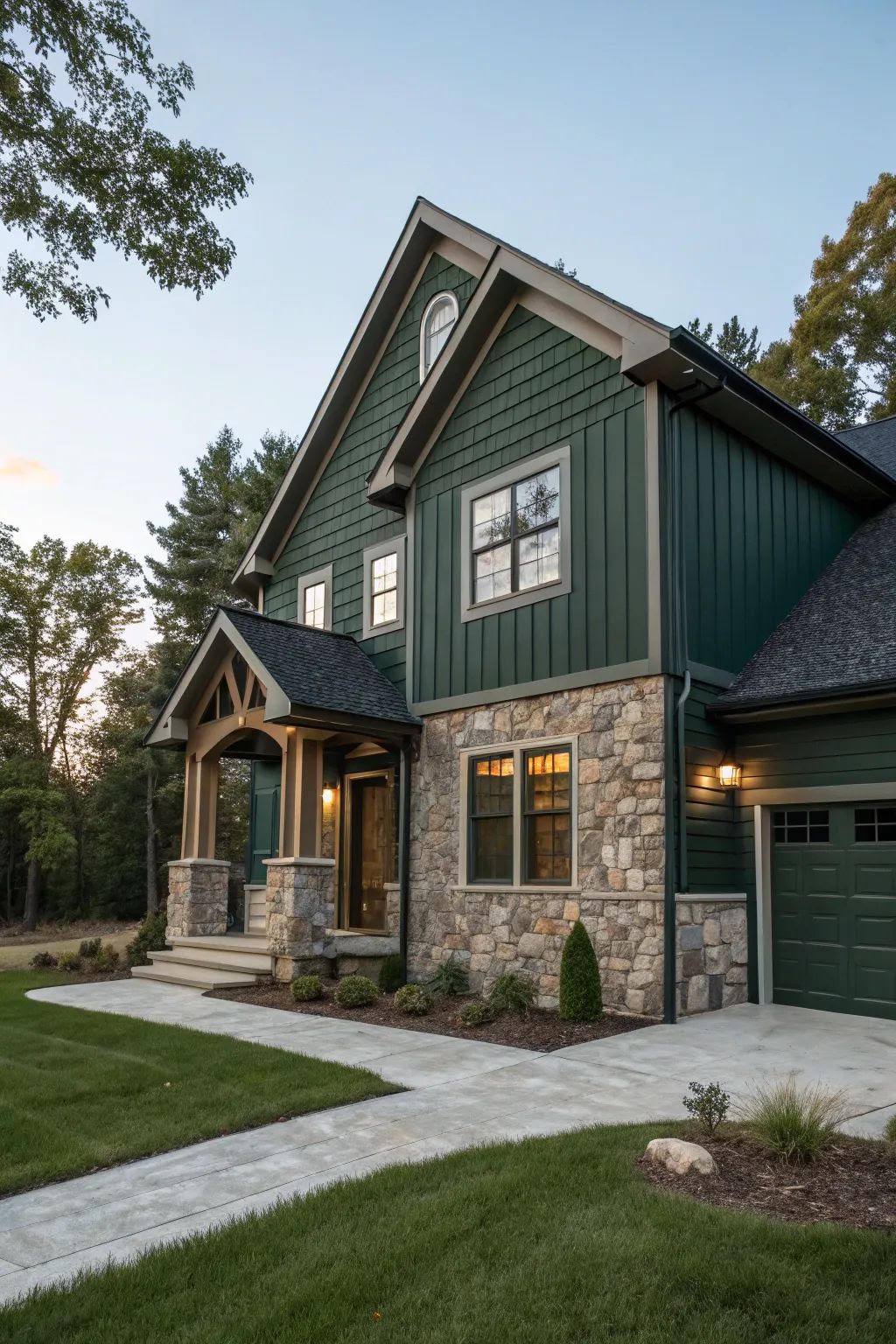
Masonry and real stone are the long answer. Brick and full-bed stone outlast the people who commission them, and the thing that fails is the mortar joint, which can be repointed. Stone veneer, done correctly, gives much of the same result, and the word correctly is doing a lot of work in that sentence: it needs a drainage plane behind it, weeps at the bottom course, proper flashing where it meets a wall or a window, and it must not be run down to grade where it can wick. Done that way, stone veneer is permanent. Done wrong it traps water against the sheathing and the failure happens behind the stone where nobody can see it.
Metal roofing belongs on this list for the same reason. A standing seam roof with a high-performance coating is a fifty-year decision, and the only part with a service life shorter than the building is the finish, which is also the part with the long warranty.
For siding and trim, the honest ranking is about maintenance rather than quality. Fiber cement holds paint well and does not rot. Real wood is beautiful and asks for attention, and on a house where the detail deserves wood we use it and tell the owner what the cycle is. Our premium exterior painting work is built around proper preparation for exactly that reason: a good paint job on well-prepared wood lasts a long time, and a good paint job over failing paint lasts two years no matter what is in the can.
Floors, the surface that gets the most use
A solid hardwood floor can be refinished several times across a century, which is why old houses still have their original floors and new houses frequently do not. Engineered wood with a real wear layer thick enough to sand is a legitimate choice, particularly over a slab or where moisture is a concern. Engineered wood with a wear layer measured in fractions of a millimeter is a printed surface with wood underneath it.
Porcelain tile is as close to permanent as a floor gets. It does not wear through because the color goes all the way in on a through-body product, and a high-quality porcelain can be genuinely handsome rather than a compromise. What fails in a tile floor is almost never the tile. It is the substrate, the movement joints that were left out, or a grout and setting method that was wrong for the application. That is craft, not material, which is why tile installation is work we do ourselves.
Natural stone floors are beautiful and have personalities. Marble etches. Limestone is soft. Slate flakes slightly. An owner who knows that going in loves the floor for twenty years. An owner who was told it was indestructible is unhappy within six months, and that is a failure of honesty rather than of stone.
Ask one question about any material: is the good part the whole thing, or is the good part a coating on something else.
Cabinetry, counters and the things hands touch
Cabinetry is where the difference between materials is most visible in daily life and least visible in a photograph. Plywood boxes rather than particleboard, solid wood doors and drawer fronts, dovetailed drawer boxes, and full-extension hardware rated for real cycles. The finish matters as much as the wood: a catalyzed conversion finish takes a wet hand and a cleaning product; a thin lacquer does not.
Counters are a question of behavior rather than quality. Quartz is consistent, dense and essentially maintenance-free, and it does not love heat. Granite is hard and takes heat. Marble is the most beautiful and the least forgiving, and in a working kitchen it will etch where somebody set a lemon down. Soapstone darkens and scratches and both of those are part of the appeal. There is no wrong answer here, only an answer that does not match the household, and that is a conversation rather than a specification.
Plumbing fixtures are worth saying something blunt about. A solid brass valve body with a good cartridge lasts decades and the cartridge is replaceable. A plated plastic body in the same finish looks identical in a showroom and is not repairable. This is the clearest example in the house of paying for the inside of the thing rather than the outside.

Windows and doors, the part owners rush
Windows are the single component where an owner’s attention and the component’s importance are furthest apart. They are structural openings, weather barriers, the main source of air leakage, and the thing you look through every day, and they are usually chosen from a brochure in the last ten minutes of a selections meeting.
The frame material is the long question. Clad wood, meaning a wood interior with an aluminum exterior skin, is the premium answer and is what we specify on most estate work: the inside can be stained or painted to match the trim and the outside never needs paint. Fiberglass is dimensionally stable and holds a finish well. Vinyl performs adequately in the middle of its life and the failure is the welded corner and the hardware, neither of which is repairable.
Then there is how the window is installed, which outranks the window itself. A good unit set without a sill pan and without the flashing lapped in the correct order will leak into the wall, and the manufacturer’s warranty will not help. We install our own openings for this reason.
Exterior doors deserve the same scrutiny, and the hardware on them more than the door. A real mortise lockset feels different in the hand and lasts for generations. On an entry door, that first moment of touching the handle is the first physical impression anybody has of a house, and it is cheap to get right.
Style ages faster than material
The thing that actually dates a house is rarely the material. It is the trend the material was chosen to express.
Stone, wood, plaster, tile, brick and metal have all been in use for a very long time and none of them read as belonging to a decade. What reads as 2008 or 1994 is a specific profile, a specific color temperature, a specific edge detail on a counter, a particular arrangement of glass block. So when an owner asks what will look dated, my answer is usually to keep the architecture quiet and let the material be the interest.
That is the practical argument for restraint. A simple, well-proportioned room with real materials and careful trim work will look considered in thirty years. A room with a strongly fashionable treatment is going to require somebody to redo it, which is the opposite of building for generations.
Where to spend and where it does not matter
If a house has to be built with priorities, and nearly every house does, the order I would put them in is: the things you cannot change later, then the things you touch every day, then the things that are visible.
Structure, drainage, the envelope, the roof and the windows are first, because every one of them is disruptive or impossible to improve afterward. Then cabinetry, flooring, doors and hardware, because those get used constantly. Then the decorative layer, which can be changed in ten years by anybody.
What does not matter as much as people think: paint color, which is a weekend; light fixtures, which unscrew; and most of the items an owner agonizes over at a showroom while the window specification sits unexamined in a folder.
Go through the selections with us
We will tell you plainly how each material behaves over twenty years, including the ones with inconvenient answers, and we will tell you where the money is best spent and what the work will cost.
Reach Samuel at (937) 818-6177 or use the contact page. Look through the gallery and read about our luxury home builds.