October 2026
An outdoor room here is used hard for five months and then sits through a winter that tries to take it apart. Water gets into things, freezes, expands, and does it again forty times between November and March. Everything that fails outdoors in Ohio fails for that reason.
Freeze-thaw is the design condition
Water expands when it freezes. If it is sitting in a crack in concrete, inside a porous stone, under a paver, or in the soil around a post, that expansion has to go somewhere. In a single winter the movement is small. Across twenty winters it lifts slabs, spalls concrete surfaces, pushes stone veneer off a wall and heaves a patio out of level.
So the whole approach outdoors is about keeping water from being trapped where it can freeze: drain it away, give it somewhere to go, and use materials that tolerate being wet and then cold. That single idea explains almost every detail that follows.
Footings, and why depth is not optional
Frost works down into the soil. Anything with a footing above where the frost reaches will be lifted by that soil in winter and set back down imperfectly in spring, which is how a pergola post ends up out of plumb and a patio develops a hump at one end.
So the posts for a pergola, a covered structure, a deck or an outdoor kitchen get footings carried below the frost line, which in this region is a real depth we do not cheat on. Those footings get poured on undisturbed soil, not on backfill, and they are sized for the actual load above them rather than to a default.
An attached deck has a second concern: the ledger where it connects to the house. A ledger bolted through siding without flashing behind it will rot the rim joist of the house, and that failure is both expensive and completely invisible until a deck comes off a wall. We flash the ledger properly and use the correct structural fasteners, because this is the detail that hurts people when it is wrong.

Clay soil, and what it does to a patio
Much of Preble, Butler, Warren and Montgomery County sits on heavy clay. Clay holds water rather than draining it, and soil full of water is soil that moves when it freezes.
That changes how we build a patio. A paver patio needs a deep compacted aggregate base, deeper here than a sandy-soil installation would need, placed and compacted in lifts rather than dumped and raked. The base has to drain, which means the water that gets through the joints has somewhere to go instead of sitting against the underside of the pavers all winter. On a problem site that means a drain in the base itself.
It also changes the edge. A paver field is only as stable as its restraint, and an edge that fails lets the whole field creep outward one winter at a time. We also set a positive slope away from the house, a consistent fall across the whole surface so water never pools, because standing water on a patio in December is a freeze waiting to happen.
For poured surfaces, decorative concrete here needs the right mix for freeze-thaw exposure, air entrainment in that mix, control joints placed where we want the slab to crack rather than where it decides to, and a sealer appropriate for a surface that will see de-icing salt. A beautiful stamped surface that was not specified for this climate will start losing its face in about three winters.
Nothing outdoors fails because of the cold. It fails because water was allowed to sit somewhere and then the cold arrived.
What actually survives, material by material
- Composite decking, which does not rot, does not need to be stained every two years, and tolerates wet and freezing without checking or cupping the way wood does. It is the reason we build almost all of our composite decks rather than wood.
- Pressure-treated framing underneath, with the correct hardware, because ordinary fasteners corrode in treated lumber.
- Natural stone with low absorption. A dense stone takes on little water and handles the cycle; a soft, thirsty stone spalls.
- Full-depth clay or concrete pavers rather than thin veneer units on an exterior walking surface.
- Heavy timber for pergolas, detailed so water drains off rather than collecting in a joint, because a flat horizontal surface holding water is where timber rots first.
- Stainless or properly coated hardware everywhere, since one rusting bracket stains a stone wall permanently.
Outdoor kitchens need the same thinking as indoor ones
An outdoor kitchen has two problems a kitchen inside does not: it freezes, and it gets rained on.
So the plumbing has to be designed to be drained and shut off for winter, with the shutoff somewhere a homeowner will actually use it rather than buried behind a cabinet door. Electrical needs proper exterior-rated devices and covers. Cabinetry has to be a material intended for outdoors, meaning stainless, marine-grade polymer or masonry, because ordinary cabinetry outside lasts two seasons. Counters want a dense stone or concrete rather than anything that absorbs.
The layout question is simpler than inside and gets ignored anyway: put the grill where the smoke does not blow into the seating, and put the counter where a person can set a platter down without turning around. On covered structures the grill needs real clearance and ventilation, which is a design decision rather than something to work out on installation day.
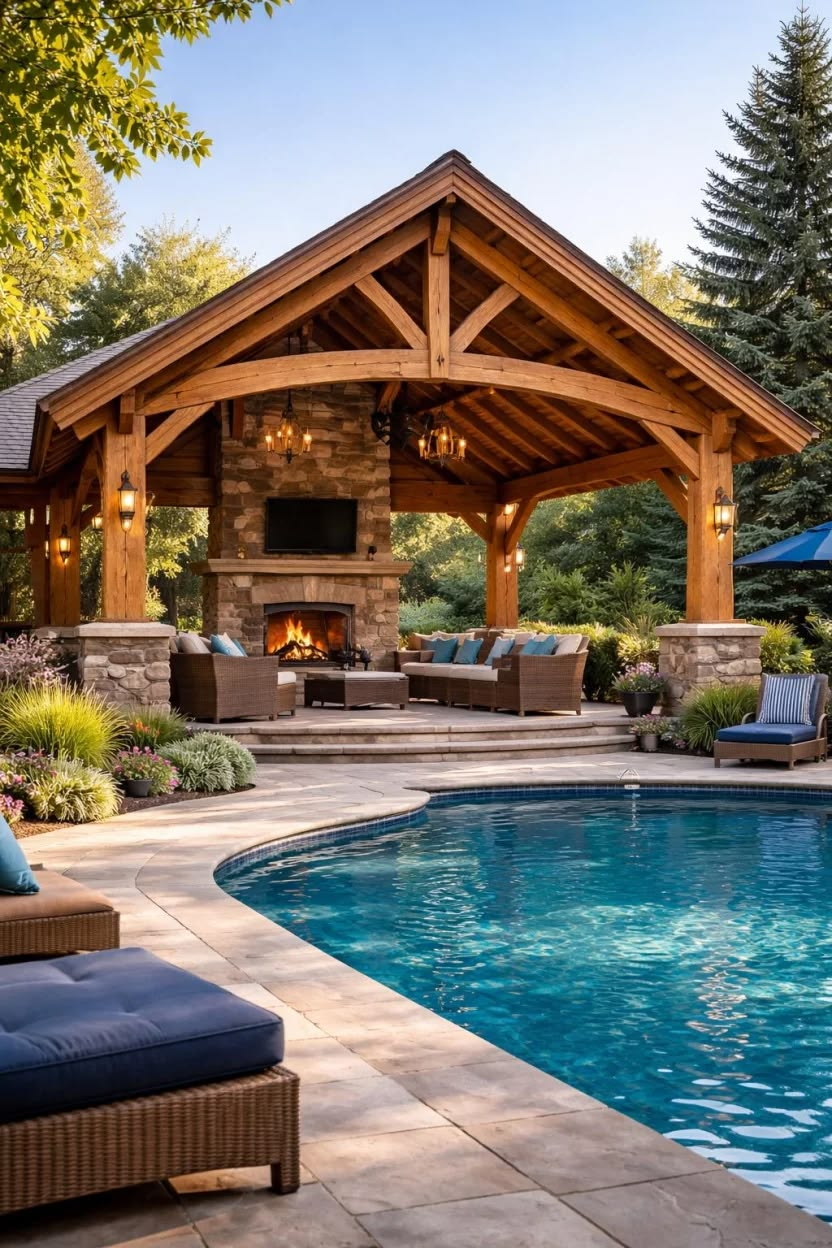
Pools, grade and the walls that hold it
A pool on a sloped lot is a sitework project before it is a pool. The deck around it has to drain away from the water, the grade behind it has to be held, and the soil pressure behind a terrace wall in saturated winter clay is considerably higher than most people assume.
That is why a retaining wall on a pool terrace is engineered rather than stacked: a proper base, drainage stone and a drain line behind the wall, geogrid tied back into the slope where the height calls for it, and a cap detail that does not let water run down behind the face. Walls fail from water pressure behind them, almost never from the weight above them.
What the winter maintenance looks like
Built right, an outdoor space here needs very little, and the little it needs matters. We hand owners a short list rather than a manual.
Shut off and drain the exterior water before the first hard freeze, which on an outdoor kitchen means the supply line and anything feeding an ice maker or a sink. Blow out the irrigation. Disconnect and store hoses, because a hose left attached holds water back into the sillcock and splits it.
On surfaces, the thing to avoid is rock salt. Sodium chloride is hard on concrete and harder on new concrete, and it attacks the mortar joints in stone work. A first-winter slab should not see de-icer at all. After that, a calcium magnesium acetate product or plain sand does the job without eating the surface. Owners are frequently surprised by this one, and it is the single easiest way to ruin a beautiful patio.
Keep the drains and the gutter discharge clear, since the whole system depends on water leaving. And resist the urge to pressure wash aggressively in spring. A heavy wand on a paver field strips the joint sand and on decorative concrete it takes the sealer off, which means the surface is then unprotected going into the following winter.
Designing for the months nobody mentions
The last thing is the one owners appreciate most later. An outdoor room that only works in July is half a room. A covered structure, a fireplace or a fire feature, and lighting that makes the space usable after six in the evening turn three usable months into seven. Fall in this part of Ohio is the best season to be outside and it is the season most patios sit empty, because nobody planned for it.
So we ask when the family will actually be out there, and we design for the edges of the year rather than the middle of it.
Walk the yard with us
Grade, drainage and sun direction are things to look at standing in the yard, not on a plan. We will come out, look at where the water goes, and tell you what the site will support and what the work will cost.
Samuel is at (937) 818-6177, or send the details through our contact page. Outdoor projects are in the gallery.